
Abstract
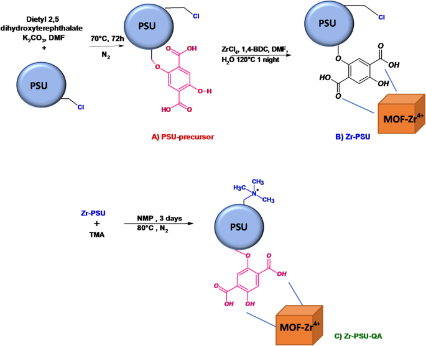
Hybrid polymers based on polysulfone (PSU), covalently functionalized with zirconium-organic moieties, were developed and applied for arsenic removal from wastewater. The synthesis strategy involved anchoring a terephthalate moiety onto PSU to act as a metal–organic framework (MOF) linker, followed by MOF assembly and subsequent quaternization (QA) with trimethylamine (TMA). The covalent incorporation of MOF-like units within the polymer backbone effectively minimized the risk of leaching; indeed, Zr release under highly basic conditions was measured at less than 1% of the total Zr content. Two materials, Zr-PSU and Zr-PSU-QA, were synthesized, characterized, and tested for As(III) and As(V) adsorption. The adsorption efficiency was assessed using ICP analysis at different pH values (3, 7, and 12) to account for variations in the charge of the Zr-organic moieties and the speciation of arsenic. Two arsenic concentrations (0.5 and 1 mM) were investigated. The results demonstrated that Zr-PSU at pH = 3 achieved a removal efficiency (RE%) of 77% for As(V), attributed to the positively charged Zr-framework at this pH. At neutral pH, significant As(III) adsorption was also observed. Additionally, Zr-PSU-QA at pH = 12 exhibited an RE% of 35% for As(III) due to the positively charged ammonium moieties in the polymer matrix. Kinetic studies for Zr-PSU at pH = 3 (As(V)) showed a plateau within 8 h, fitting a pseudo-second-order model. Regeneration with NaCl enabled partial recovery, which increased to 98.9% after four cycles when the hybrid material was supported on glass beads (GBs). Compared with previously reported Zr–MOF/polymer composites, this covalently integrated system exhibits enhanced structural stability, low leaching, and combined adsorption–ion exchange functionality. The results demonstrate the potential of Zr-PSU and Zr-PSU-QA as robust, regenerable materials for heavy-metal removal and their suitability for integration into flow-through water treatment systems.
Illustrations
Details
Published on: Journal of Inorganic and Organometallic Polymers and Materials 2025.
https://doi.org/10.1007/s10904-025-04117-4
Authors: A. V. Montella, M. Bastianini, M. Sisani, I. Ahmed, E. Sgreccia, M. L. Di Vona & R. Narducci